Searching for a lipid profile test usually starts with one of three questions: what does it actually check, do I need to fast, and what counts as normal? This guide answers all three, plus the fasting-hours confusion, the LDL danger zone, and whether the test can actually detect a blockage.
What Is a Lipid Profile Test? (Full Form & Meaning)
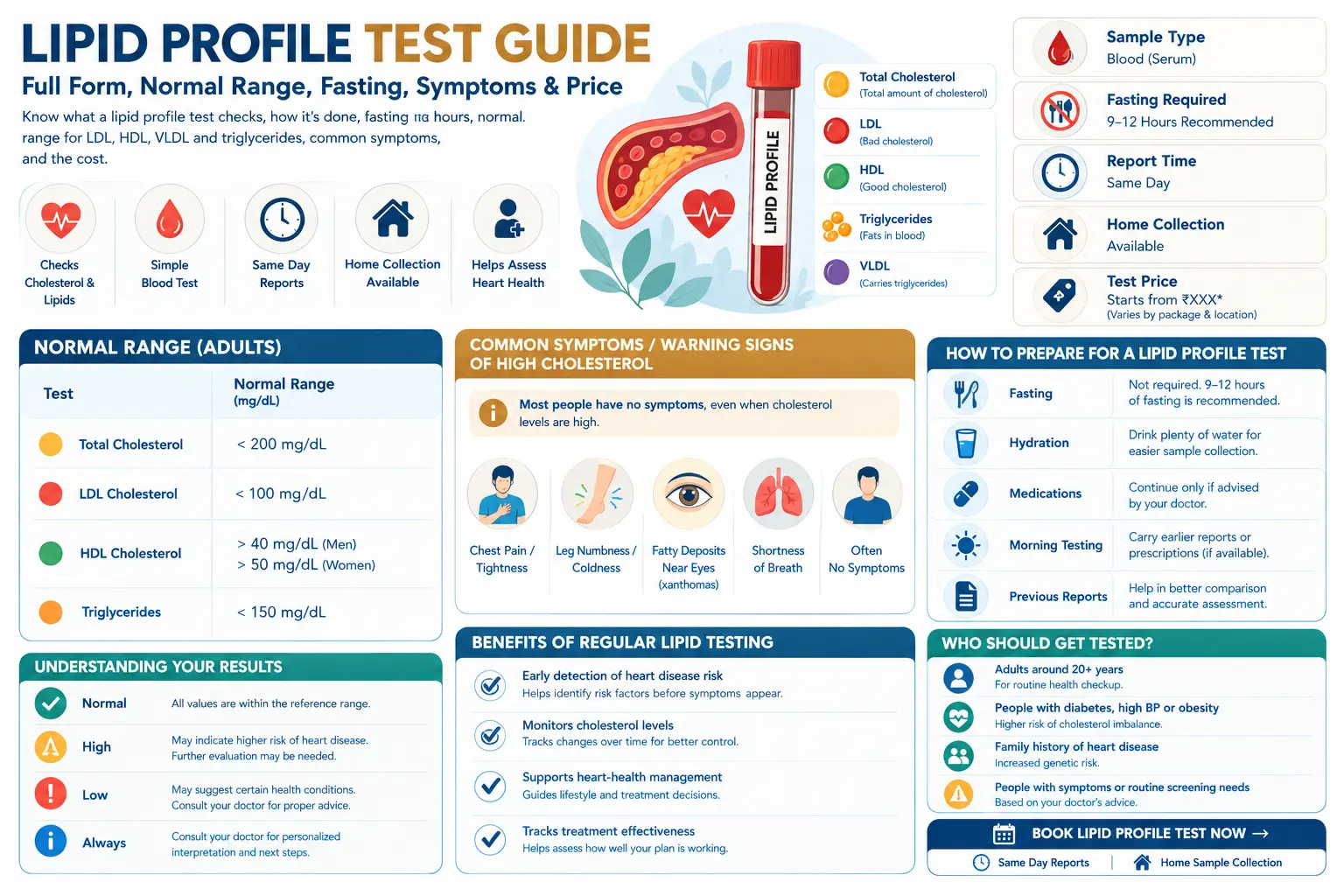
Lipid profile doesn't have a medical 'full form' the way CBC does — 'lipid profile' simply means a profile (panel) of the fats, or lipids, in your blood. It's a single blood test that reports several values together: Total Cholesterol, LDL, HDL, Triglycerides, and VLDL.
Lipid Profile Test List: What's Included
- Total Cholesterol
- LDL Cholesterol (Low-Density Lipoprotein)
- HDL Cholesterol (High-Density Lipoprotein)
- Triglycerides
- VLDL Cholesterol (Very Low-Density Lipoprotein)
- Cholesterol/HDL Ratio (calculated, not separately measured)
What Are HDL, LDL, and VLDL?
All three carry cholesterol through your blood, but they behave differently. LDL is called 'bad' cholesterol because high levels deposit cholesterol into artery walls. HDL is 'good' cholesterol because it carries excess cholesterol away for disposal. VLDL mainly carries triglycerides and is usually estimated, not measured directly, from your triglyceride value.
How Is a Lipid Profile Test Done? (Procedure)
It's a standard blood draw — a small sample is taken from a vein in your arm. The lab spins the sample to separate the serum (which is why you'll sometimes see it called a 'lipid profile serum test'), then runs it through an automated analyzer to measure each component. The draw itself takes a couple of minutes.
Is a Lipid Profile Test Painful or Safe?
No more than any routine blood draw — a brief needle prick with mild, short-lived discomfort. It's a standard, low-risk test; minor bruising at the site is the most common side effect, and it resolves on its own.
Is Fasting Required for a Lipid Profile Test?
Yes, fasting is the conventional recommendation, mainly because eating temporarily raises triglycerides and can skew the calculated LDL value. Some labs and doctors do order non-fasting lipid panels for general screening, but fasting is still the safer default if you want the most accurate individual numbers, especially for triglycerides.
How Many Hours of Fasting? Is 7 Hours Enough, or Do You Need 12?
The commonly recommended window is 9-12 hours. Seven hours is on the short side and may not fully settle your triglyceride levels after a meal, so it's better to aim for at least 9 hours if you can. The reason labs ask for up to 12 hours is simply to give triglycerides enough time to return to your fasting baseline, since they're the value most sensitive to recent food intake.
Can You Drink Water Before a Lipid Profile Test?
Yes. Plain water doesn't break a fast and is actually encouraged — staying hydrated makes the blood draw easier. Avoid anything besides water: no tea, coffee, juice, sugary drinks, or alcohol during the fasting window.
Best Time of Day for a Lipid Profile Test
Morning appointments are the most practical choice simply because an overnight fast lines up naturally with waking up — you fast through the night and get tested before breakfast. There's no strict medical rule that it must be morning, but it's the easiest way to hit the fasting window without extra effort.
Lipid Profile Test Normal Range
- Total Cholesterol: Less than 200 mg/dL
- LDL Cholesterol: Less than 100 mg/dL
- HDL Cholesterol: Above 40 mg/dL (men), above 50 mg/dL (women)
- Triglycerides: Less than 150 mg/dL
Some labs or international reports use mmol/L instead of mg/dL — to convert, divide cholesterol values (mg/dL) by about 38.67, and triglycerides by about 88.57. Normal ranges can vary slightly by lab and by sex, including the female-specific HDL threshold above, so always check the range printed on your own report.
How Is LDL Calculated?
Most labs don't measure LDL directly — they calculate it using the Friedewald formula: LDL = Total Cholesterol − HDL − (Triglycerides ÷ 5). This calculation becomes unreliable when triglycerides are very high (above roughly 400 mg/dL), in which case the lab may measure LDL directly instead.
What Is the Danger Zone for LDL Cholesterol?
As a general guide, LDL of 160-189 mg/dL is considered high, and 190 mg/dL or above is considered very high. These are population-level cutoffs — your own risk also depends on your age, other conditions, and family history, which is why your doctor looks at the full picture rather than one number alone.
5 Signs of High Cholesterol (and Why They're Easy to Miss)
High cholesterol is often called a silent condition because it usually causes no symptoms at all until it leads to a complication. When signs do eventually appear, they tend to reflect advanced plaque buildup rather than cholesterol itself:
- Chest pain or tightness (angina) from narrowed arteries
- Numbness or coldness in the legs from reduced blood flow
- Yellowish fatty deposits under the skin, often near the eyes (xanthomas)
- Shortness of breath with exertion
- No symptoms at all, in most people, until a cardiac event occurs
What Causes High Cholesterol?
- A diet high in saturated fat, trans fat, and processed food
- Lack of physical activity
- Obesity or excess body weight
- Smoking, which lowers HDL
- Genetics and family history
- Underlying conditions like diabetes or hypothyroidism
Foods to Avoid and Foods That Help Lower Cholesterol
Foods to limit: fried food, red and processed meat, full-fat dairy, baked goods made with butter or ghee, and packaged snacks high in trans fat. Foods that help: oats and whole grains, beans and lentils, nuts, fatty fish rich in omega-3s, and plenty of vegetables and fruit — all of which support a healthier cholesterol ratio over time alongside regular exercise.
What If My Lipid Profile Is High or Abnormal?
An abnormal result doesn't mean a diagnosis on its own — it means your doctor will look at which value is off (LDL, HDL, or triglycerides), by how much, and alongside your age, weight, family history, and any existing conditions before deciding on lifestyle changes, monitoring, or medication.
Can a Lipid Profile Test Detect Blockage or Fatty Liver?
No. A lipid profile only measures the fats circulating in your blood — it can't see inside your arteries or your liver. Confirming an actual blockage needs imaging such as an angiography, and fatty liver needs a liver function test or an ultrasound. Think of the lipid profile as a risk indicator, not a picture of what's physically happening in an artery or organ.
At What Age Should You Start Checking Your Lipid Profile?
Routine screening is commonly recommended from around age 20, and more frequently — sometimes annually — for people with diabetes, high blood pressure, obesity, or a family history of heart disease.
Lipid Profile Test Price and Report Time
Our lipid profile test is priced at 450, with same-day reports and free home sample collection available — so you don't need to visit the lab in person or wait days for results.
Lipid Profile Test Services & Pricing
Explore lipid profile test details, pricing, and convenient home sample collection services.
Lipid Profile Test in Panchkula, Chandigarh & Nearby Areas
Shyam Budget Friendly Labs provides accurate lipid profile testing with convenient home blood sample collection for patients across Panchkula, Chandigarh, Mohali, Zirakpur, Sector 21 Panchkula, Karimpur, Pinjore, and Kalka.
Lipid Profile Test — Areas We Serve
We provide lipid profile (cholesterol) testing with home sample collection across the following locations.
Key Takeaways
- A lipid profile measures Total Cholesterol, LDL, HDL, VLDL, and Triglycerides in one serum blood test
- 9-12 hours of fasting is recommended, mainly to get an accurate triglyceride reading
- LDL is usually calculated (Friedewald formula), not directly measured, unless triglycerides are very high
- The test flags cardiovascular risk — it cannot detect an actual blockage or fatty liver on its own
- High cholesterol has no symptoms in most people, which is why routine testing from around age 20 matters
References
- Cholesterol Testing and Results — MedlinePlus
- HDL, LDL, and Triglycerides — American Heart Association
- Cholesterol: Top Foods to Improve Your Numbers — Mayo Clinic
Common Questions
Find answers to the most commonly asked questions about this health topic.
There isn't a medical acronym to expand — 'lipid profile' means a panel of the different fats (lipids) in your blood, covering Total Cholesterol, LDL, HDL, Triglycerides, and VLDL.
Book Lipid Profile Test
Get accurate cholesterol testing with doorstep sample collection and same-day reports.
Related Diagnostic Tests
These lab tests are closely related to this topic. Book with home sample collection for fast, accurate reports.
Related Health Packages
Based on this article, these preventive health packages may help you better understand your health.
Thyroid Test Guide: TSH, T3, T4, Normal Range, Symptoms & Price
Everything you need to know about the thyroid test — TSH, T3, T4, normal range, symptoms of thyroid problems, fasting rules, price, and when to get tested.
LFT Test: Full Form, Normal Range, SGOT SGPT & Price
LFT test full form, how to read your report, SGOT and SGPT normal range, causes of high liver enzymes, fatty liver, fasting rules, and price.