A fever that keeps climbing for several days, with weakness and stomach upset, is the classic picture that makes doctors think of typhoid. This guide explains the typhoid tests (Widal, Typhidot, and blood culture), how to read their results, and what to expect from symptoms, treatment, diet, and recovery.
What Is a Typhoid Test? (Meaning and Test Names)
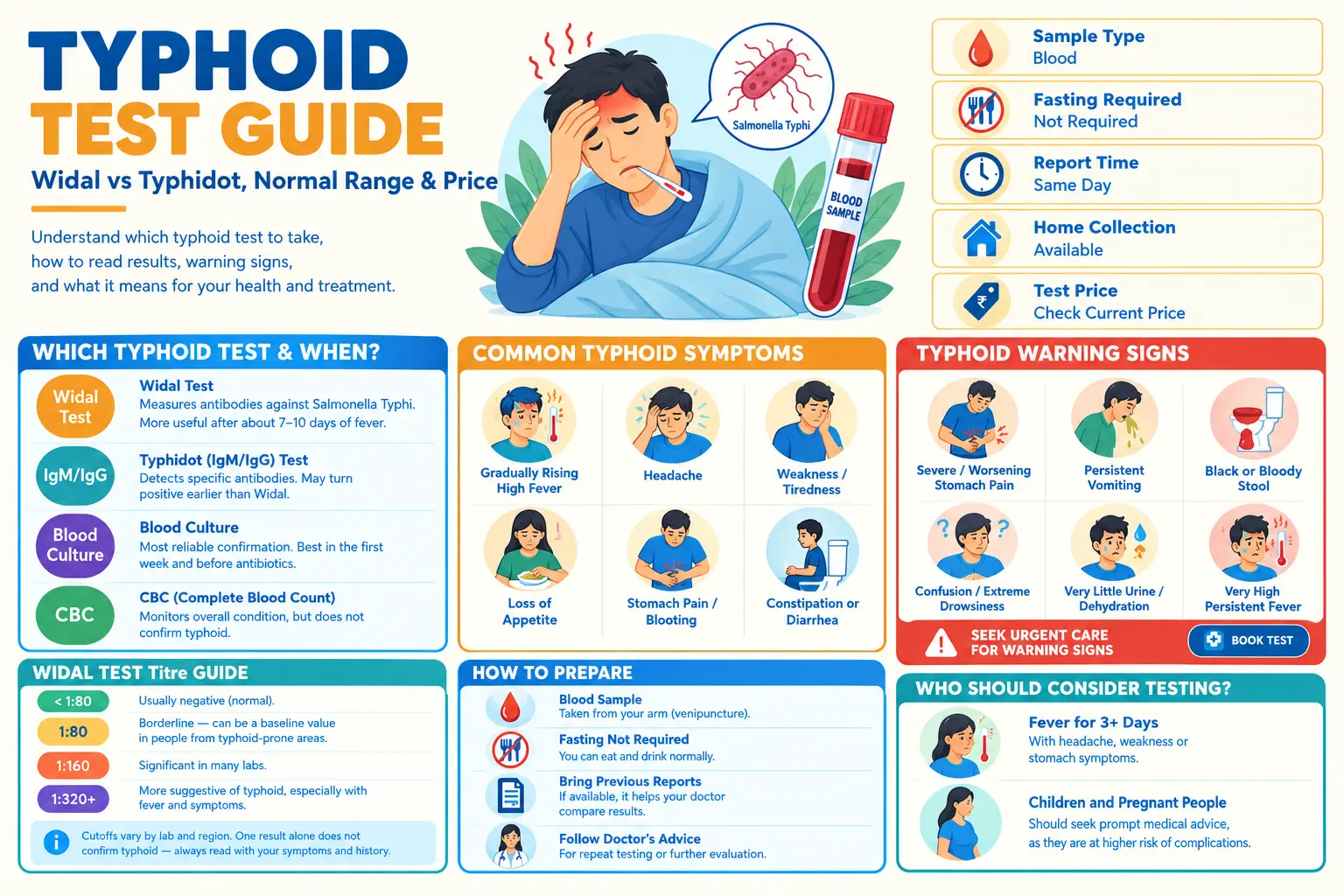
A typhoid test checks for infection with Salmonella Typhi, the bacterium that causes typhoid (enteric) fever. There is no single test called 'the typhoid test' — it can mean the Widal test, the Typhidot test, or a blood culture, and doctors often use them together with your symptoms.
Typhoid Test Types
- Widal test — measures antibody titres; useful after about a week of fever
- Typhidot test — detects IgM and IgG antibodies; a rapid test that can turn positive earlier
- Blood culture — grows the bacteria from your blood; the most reliable confirmation, best in the first week and before antibiotics
- Stool or urine culture — sometimes used later in the illness or to look for carriers
- PCR — detects bacterial DNA; used mainly in specialised labs
What Is the Widal Test? (Full Form)
The Widal test has no full form — it is named after the French physician Georges Fernand Widal. It measures antibodies against Salmonella Typhi 'O' and 'H' antigens, and Paratyphi 'AH' and 'BH' antigens, reported as titres like 1:80, 1:160, or 1:320.
Widal Test Normal Range and Titre Chart
- Below 1:80: negative (normal)
- 1:80: borderline — can be a baseline value in people who live where typhoid is common
- 1:160: considered significant by many labs
- 1:320 or higher: more strongly suggestive of typhoid, when you also have fever and symptoms
- A four-fold rise between two samples taken 7-10 days apart is the most meaningful pattern
Cut-offs vary by lab and region, and the ranges are the same for men and women. So a report showing 'typhoid 1:80' or 'TO 1:160' needs to be read with your fever history rather than on its own.
Is 1:80, 1:160, or 1:320 Positive on a Widal Test?
1:80 is usually low-level and often not diagnostic by itself. 1:160 is significant in many labs and, with fever for a week or more, supports typhoid. 1:320 or above is a stronger signal. None of these alone proves typhoid, and a high titre can also remain after a past infection or vaccination.
How Accurate Is the Widal Test? Why False Positives Happen
Widal has limited accuracy. False positives can come from a past typhoid infection, typhoid vaccination, other infections such as malaria or dengue, and normal baseline antibodies in endemic areas. False negatives happen when it is done too early or after antibiotics. That is why a single Widal result is read with the clinical picture and, if needed, repeated.
Widal Test After How Many Days of Fever?
Antibodies usually become detectable after about 7-10 days of fever, so Widal done in the first few days can be falsely negative. If your first test was early and symptoms continue, doctors often repeat it after several days.
What Is the Typhidot Test? (IgM and IgG)
Typhidot is a rapid test that detects IgM and IgG antibodies against Salmonella Typhi. It can turn positive within about 2-3 days of fever and gives a quick result. Remember that Typhidot is the name of a test and typhoid is the disease, so they are not the same thing.
Typhidot Results: What IgM Positive and IgG Positive Mean
- IgM positive: recent or current infection
- IgM and IgG both positive: acute or early infection
- IgG positive only: past exposure, or a later stage
- Both negative: no antibodies detected — can still be a false negative in the first day or two of fever
A positive Typhidot IgM strongly supports typhoid with a matching fever, but it does not confirm it, as IgM can stay positive for weeks and other infections can occasionally cross-react.
Widal vs Typhidot: Which Test Is Better?
- Typhidot: earlier (about day 2-3), quick result, but less specific and IgM can persist after recovery
- Widal: more useful after the first week, cheaper, but prone to false positives and needs the clinical context or a rising titre
- Blood culture: the most reliable, shows which antibiotic works, but takes 2-5 days and works best before antibiotics
No single test is perfect. The better choice depends on how many days of fever you have had, and doctors often combine the result with symptoms and a CBC.
Which Test Can Confirm Typhoid?
Blood culture is the standard confirmation because it identifies the bacteria itself. Widal and Typhidot are supportive tests that show your immune response. When culture isn't done or the antibiotic has already been started, doctors rely on the combination of symptoms and antibody tests.
Can a CBC Detect or Confirm Typhoid?
No. A CBC cannot confirm typhoid. It may show a low white cell count, mild anemia, or lowered platelets, which fit typhoid but also fit other fevers, and it can be normal. It is added to monitor the illness rather than to diagnose it.
Typhoid Fever Symptoms (Early and Common)
- Fever that rises step by step over several days, often reaching 103-104°F
- Headache
- Weakness and tiredness
- Loss of appetite
- Stomach pain or bloating
- Constipation or diarrhea
- Dry cough
- Body ache
- Rose spots — small pink spots on the chest or abdomen
- A heart rate that is slower than expected for the fever
A fever of 104°F can occur in untreated typhoid and needs medical attention. Children may show only fever and irritability or poor feeding.
Typhoid Fever Stages, Duration, and Incubation Period
- Incubation: usually 1-3 weeks after exposure, before symptoms start
- Week 1: fever rising step by step, headache, cough, weakness
- Week 2: persistent high fever, stomach symptoms, rose spots, marked weakness
- Week 3: complications become more likely if untreated, such as intestinal bleeding or perforation
- Week 4 onward: slow recovery if untreated; with treatment, fever settles much sooner
Typhoid vs Dengue vs Malaria vs Viral Fever
- Typhoid: gradually rising fever, stomach upset, weakness, constipation or diarrhea
- Dengue: sudden high fever, severe body ache, pain behind the eyes, rash, falling platelets
- Malaria: fever with chills and shaking, often in cycles
- Viral fever: milder, short course, often with cold and cough
Symptoms overlap and two infections can occur together, especially in the monsoon, so doctors rely on tests such as Widal or Typhidot, dengue NS1 and IgM, and malaria antigen rather than symptoms alone.
What Causes Typhoid Fever?
Typhoid spreads through the faecal-oral route: food or water contaminated by the faeces or urine of an infected person or a carrier. Poor sanitation, unsafe street food, uncovered food, and unboiled water are the main risks.
Typhoid Treatment and Antibiotics
Typhoid is treated with antibiotics prescribed by a doctor, together with rest and plenty of fluids. Commonly used antibiotics include azithromycin and third-generation cephalosporins such as ceftriaxone or cefixime, but resistance is widespread and some older antibiotics no longer work, so the choice depends on local patterns and sometimes culture results. Never self-medicate, and finish the full course even after the fever settles.
Is Typhoid 100% Curable? Recovery Time and Seriousness
Most people recover fully with timely, correct antibiotics. Fever often starts easing in about 3-5 days of the right treatment, but the full course usually runs 7-14 days and weakness can last for weeks. A small number of people relapse or become carriers. Typhoid can be serious if left untreated, with complications such as intestinal bleeding or perforation, which is why early testing matters.
Typhoid Diet: What to Eat and Foods to Avoid
Eat soft, easily digestible, energy-rich food in small, frequent meals, with plenty of boiled or filtered water, ORS, soups, and coconut water. Good choices include khichdi, rice with dal, boiled potato, banana, curd, toast, and well-cooked vegetables. Avoid spicy, oily, and fried food, raw salads, street food, unwashed fruit, unboiled or unpasteurised milk, and alcohol until you recover.
When to Go to Hospital
- Severe or worsening stomach pain
- Black stools or blood in the stool
- Persistent vomiting and inability to drink
- Confusion, extreme drowsiness, or delirium
- Very high fever that does not come down
- Signs of dehydration such as very little urine
Typhoid Prevention and Vaccine
Drink boiled or properly filtered water, wash hands with soap before eating and after using the toilet, eat freshly cooked food, and avoid ice and street food of doubtful hygiene. Typhoid conjugate vaccine (TCV) is recommended in areas where typhoid is common and gives longer protection than older vaccines, but no vaccine is 100% effective, so hygiene still matters. Ask your doctor which vaccine suits you or your child.
Typhoid Test for Children and in Pregnancy
Children with fever lasting more than 3 days, especially with stomach upset or poor feeding, should be tested. Pregnant women with persistent fever should see a doctor promptly, since typhoid in pregnancy needs timely treatment and the doctor must choose an antibiotic that is safe for pregnancy.
Is Fasting Required? Can I Test for Typhoid at Home?
No fasting or preparation is needed for Widal or Typhidot. Typhoid cannot be confirmed by symptoms or by home rapid kits reliably, but you can book home sample collection — a phlebotomist collects the blood and the test is done at the lab, with the report usually ready the same day or within 24 hours.
Typhoid Test Price and Report Time
Our Widal test is priced at 200 and the Typhidot test at 400, with same-day reports and free home sample collection available. A CBC is a separate test that doctors commonly add.
Typhoid Test Services & Pricing
Explore Widal and Typhidot test details, pricing, and convenient home sample collection services.
Typhoid Test Price
Check the latest Widal and Typhidot prices and home sample collection options.
Widal Test Details
Learn about the Widal test, titre chart, sample requirements, and preparation.
Typhidot Test Details
Learn about the Typhidot IgM and IgG test, what it detects, and preparation.
Typhoid Test in Panchkula, Chandigarh & Nearby Areas
Shyam Budget Friendly Labs provides accurate typhoid testing with convenient home blood sample collection for patients across Panchkula, Chandigarh, Mohali, Zirakpur, Sector 21 Panchkula, Karimpur, Pinjore, and Kalka.
Typhoid Test — Areas We Serve
We provide Widal and Typhidot testing with home sample collection across the following locations.
Key Takeaways
- Widal and Typhidot are supportive tests; blood culture is the most reliable confirmation
- Typhidot can turn positive from about day 2-3 of fever, while Widal is more useful after about day 7-10
- A Widal titre of 1:80 is often borderline, 1:160 is significant in many labs, and 1:320 or higher is more suggestive
- Typhoid and Typhidot are not the same — one is the disease, the other a test
- Most people recover fully with the right antibiotic from a doctor, so don't self-medicate or delay testing
References
- Typhoid — World Health Organization
- About Typhoid Fever and Paratyphoid Fever — CDC
- Typhoid Fever — MedlinePlus
Common Questions
Find answers to the most commonly asked questions about this health topic.
Typhoid is checked with the Widal test, the Typhidot test (IgM and IgG), or a blood culture. Doctors often combine them with your symptoms.
Book Typhoid Test
Get accurate Widal and Typhidot testing with doorstep sample collection and same-day reports.
Related Diagnostic Tests
These lab tests are closely related to this topic. Book with home sample collection for fast, accurate reports.
Related Health Packages
Based on this article, these preventive health packages may help you better understand your health.
Dengue Test: NS1, IgM, IgG, Platelet Count & Symptoms
Dengue test explained: which test to take and when, how to read NS1, IgM and IgG results, platelet count in dengue, warning signs, and price.
HbA1c Test: Normal Range, Chart, Price & How to Lower
HbA1c test explained: full form, normal range by age, what 5.7, 6.5 and 7.5 mean, average sugar chart, fasting rules, price, and how to lower it.